


How customer-centric leadership really shows up in daily CX
When leaders talk about customer centricity it sounds simple. But as Helen Rigamonti reminds us the real impact is created inside the organization in the behaviors decision making and collaboration that shape what customers feel. In this episode Helen shares what happens when leadership truly looks at the business through the customer journey and why CX only works when it stops being a project and becomes a shared responsibility.
CX Minutes with Helen Rigamonti and our host Sabina Persson, Custellence.
What’s covered in this episode
Guest insights
- Why leadership behavior is the real CX engine
- The everyday CX practice every team should use
- The biggest mistake organizations still make
- A story where hands on CX changed everything
- How to make sure CX actually gets acted on
- Helen’s one piece of advice to every CX professional
Quick links
Why leadership behavior is the real CX engine
For Helen Rigamonti customer experience always starts on the inside. The way leaders collaborate communicate and make decisions directly shapes what customers ultimately feel.
Helen has spent more than twenty five years leading customer facing operations and now teaches and writes about customer centric leadership especially how internal alignment becomes visible in every touchpoint.
If you want to understand your culture look at your customer journey.

Related: How Curiosity Builds a Customer-Centric Culture
Deep dive: The CX leaders who stand out in 2026 won’t just “listen better.” (Medallia Inc)
The everyday CX practice every team should use
Helen’s strongest advice is simple. Bring a real customer into every conversation.
Not through dashboards. Not through charts.
Through a real story of a real person moving through the journey.
“Start with a customer story not only statistics. It is a really strong tool.” — Helen Rigamonti
Leaders often struggle to see their role in the customer journey. One story can create clarity and make the impact real.
The biggest mistake organizations still make
Helen sees the same pattern everywhere.
Companies treat CX as a project or a department instead of treating it as a shared responsibility.
This leads to problems like:
• Trying to fix CX with tools instead of behavior
• Talking about customer obsession without acting on it
• Adding a CX vision statement without operational change
• Leaving leadership outside the process

Related: Why 54% Of Customers Are Disappointed (Forbes)
More like this: 5 Proven customer experience strategies to boost your business growth
👉🏽 Start your customer journey map
A story where hands on CX changed everything
Helen shares a moment she often returns to.
A group of department heads all brought into the same room for a customer journey workshop.
It was uncomfortable. They did not see themselves as a team. Some even saw each other as internal competitors.
But something shifted once they viewed the journey together.
“It became clear that we need to collaborate for the customer. It became a turning point.” — Helen Rigamonti
By looking at goals ownership leadership and mandate through the lens of the journey the group left the room with a completely different understanding of each other and their shared responsibility.
Related: Inside The Experience Room – Designing Immersive CX Learning (Forrester)
How to make sure CX actually gets acted on
Helen’s daily practice is one single question in every decision making moment
How will this affect the customer?
“Just asking that question can be a culture shifting moment.”
Because it triggers deeper thinking.
Do we know the answer.
Do we need more insight.
Does this decision support our customer goals.
This is how CX becomes part of everyday behavior not a yearly initiative.
Related: How to Turn Customer Feedback Into Real Impact (Ennova)
Helen’s one piece of advice to every CX professional
If you want credibility speak the language leadership speaks.
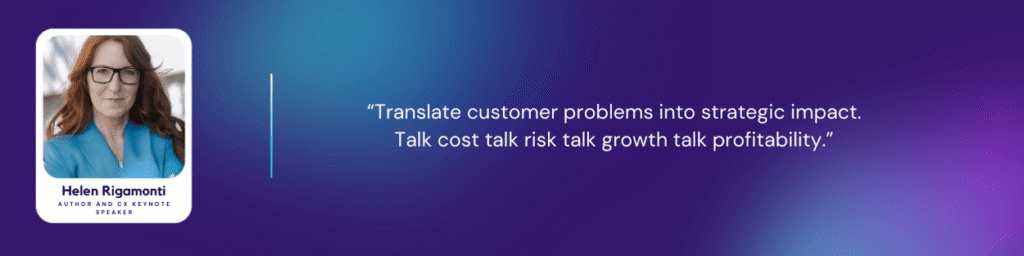
It was uncomfortable. They did not see themselves as a team. Some even saw each other as internal cThis shift moves CX from insight to business strategy. When CX professionals connect insight to financial outcomes their influence grows.
Free Course: Take Our Free Customer Journey Essentials Course
Key Takeaways
- Bring real customer stories into daily conversations
- CX breaks when it is treated as a project instead of a leadership practice
- Cross functional workshops help teams build shared ownership
- Ask how will this affect the customer in every decision
- Connect customer insights to cost risk growth and profitability
“We are not only designing journeys. We are shaping culture.” — Helen Rigamonti
👉 Want to learn more? Watch the full Episode #14 with Helen here.

Frequently asked questions (FAQ)
What does customer centric leadership mean in practice
It means using customer insight to guide decisions behaviors and collaboration across the organization including at the leadership level.
Why do CX initiatives often fail to stick
Because many organizations treat CX as a project or department instead of an ongoing leadership responsibility that requires behavioral change.
How can teams make CX more actionable
Start with a real customer story and ask in every meeting how will this affect the customer.
How do you get leadership support for CX
Translate customer problems into strategic impact by speaking about cost risk growth and profitability.
What is one practical step to break silos
Run a simple journey workshop with cross functional leaders to build shared understanding and ownership.
Final thoughts
Customer centric leadership is not a philosophy. It is a daily practice. When leaders look through the customer journey people’s behaviors shift collaboration strengthens and CX becomes a natural part of how the organization grows and decides.

AI Summary
In this episode Helen Rigamonti explains why customer centric leadership is the foundation of effective customer experience. She highlights how internal alignment shapes every touchpoint why CX fails when treated as a project and how simple practices like sharing real customer stories or asking how will this affect the customer can transform daily decision making.
Her core message is that CX becomes influential when it speaks the language of strategy and connects customer insight to cost risk growth and profitability.
Read the transcript
Note: This transcript has been lightly edited for clarity and readability.
Intro
Sabina Persson (0:00)
Hi I am Sabina Persson from Custellence and welcome to the video cast CX Minutes. It is six questions six minutes and it is all about customer experience. This is a series of episodes where we bring you actionable insights practical knowhow and personal stories from top professionals all in just six minutes. And joining me today is Helen Rigamonti. Welcome Helen. How are you
Helen Rigamonti (0:33)
Hi. I am good. Thank you for having me.
Sabina (0:40)
It is so good to have you here. So we are going to talk about hands on customer experience. And as always my first question is who are you and what do you do
Who are you and what do you do?
Helen (0:47)
I am a writer and a published author. I teach and I speak about customer experience and customer leadership and I focus a lot on how internal leadership shows up in the experience the customer feels. I spend much of my time helping organizations and helping leaders see the organization through the customer journey.
I was thinking about that when I was scheduled for this call because I actually review and assess customer journey maps for a living since my students create them. I have been leading customer facing operations for more than twenty five years and I know what it looks like when the inside is not aligned with what customers expect. My work starts with that idea. Customers feel the outcome of how we lead internally all the time.
What is one everyday CX practice that makes the biggest difference
Sabina (2:04)
So what is one everyday CX practice that will make the biggest difference in your opinion
Helen (2:13)
There has been so much smartness in this series so I tried to think of something that has not already been said. I think it is bringing a real customer into the conversation. Being good at creating the story the insight and the situation not only statistics and data but a real story about a real person doing the journey.
And then connecting that story to what leadership and management talk about. When leaders use the customer journey as a daily tool people start to connect their work with real outcomes. We struggle with that. Leadership finds it hard to make everyone see their role in the customer journey. So start with a customer story. It is a strong tip.
What is one mistake companies make when trying to improve CX
Sabina (3:20)
Good one. And what is one mistake companies make when trying to improve CX
Helen (3:26)
I meet a lot of students who work in organizations as CX professionals and I see how they struggle. It is almost always connected to the organization treating CX as a project or treating it as a department instead of something the whole organization owns.
Some companies see CX as a fluffy add on instead of the actual business idea of creating customer value in all touchpoints. And many try to fix CX with tools or technology but ignore leadership and behavior which shape decisions.
Without leaders who consistently act on customer insights we get a gap. Companies talk about customer obsession and write beautiful CX statements in their vision but few actually have a systematic approach to evaluate analyze and act on CX data across the whole organization.
Sabina (5:05)
So they talk the talk but do not walk the walk.
Helen (5:11)
Right. You can have a few ambassadors but you need the management team on board. You need to change leadership and daily operations so everyone is part of it.
A story where hands on CX changed things
Sabina (5:24)
Can you share a story where a hands on CX practice really changed things
Helen (5:31)
I see this all the time. When we put the right people in a simple customer journey workshop it creates many aha moments. One case I remember is when we put department heads together in the same room and talked about the customer journey.
These people are hard to get into a room at all. It was uncomfortable at first. Many did not see themselves as a team. Some even saw themselves as competitors in the internal political landscape.
But when we walked through the customer journey together it became clear that they needed to collaborate for the customer. It became a turning point. We talked about goals ownership leadership and mandate from a customer journey perspective and it changed how they talked.
How do you make sure CX gets acted on daily
Sabina (7:40)
How do you make sure CX does not stay theory but gets acted on every day
Helen (7:47)
It is the everyday discussions. How do we bring this into the culture. If we are in a strategic or decision making meeting we ask how will this affect the customer. That question can feel strange at first because people are looking at internal efficiency or KPIs.
But asking that question leads to realizing we may not know the answer. So we need to look at customer insight. Then goal setting. Asking the question triggers important follow up questions.
What is your one piece of advice for anyone in CX
Sabina (8:56)
And my last question. If you had one piece of advice to share with anyone in CX what would it be
Helen (9:02)
I think I have touched on this already. It is about the language we use. Connect what we do in CX to leadership and management language. Translate customer problems into strategic impact. Talk cost. Talk risk. Talk growth. Talk profitability. Build credibility.
Not by trying to convince people but by connecting CX to the language the management team already uses. We are not just designing good looking journeys. We are shaping culture and leading people so they can look into their organization through the customer’s eyes.
Sabina (10:45)
I totally agree. That is so important speaking the language that leadership actually speaks.
Helen (11:05)
Yes. We need to be great at translating. What does a customer problem mean for cost for growth for profitability. Connecting those dots is hard but important.
The leaking bucket metaphor is useful. If there are holes in the bucket and we plug one what happens to the overall customer base. What does that mean in actual money.
Wrap-up
Sabina (11:50)
Good famous last words. Thank you so much Helen. I really appreciate your time and the insights you brought. I am sure this will resonate with many people working in CX.
Helen (12:02)
Thank you so much for having me. Great to have a quick CX talk. Always happy to talk CX.
Sabina (12:15)
Quick and effective. And that is all for today. Thank you for watching and I will see you next time. Bye bye.
Check out other episodes of CX Minutes here.
By Tove Lundell