

Why CX leaders need to stop mapping and start owning
Customer experience is no longer about documenting journeys. It is about owning them.
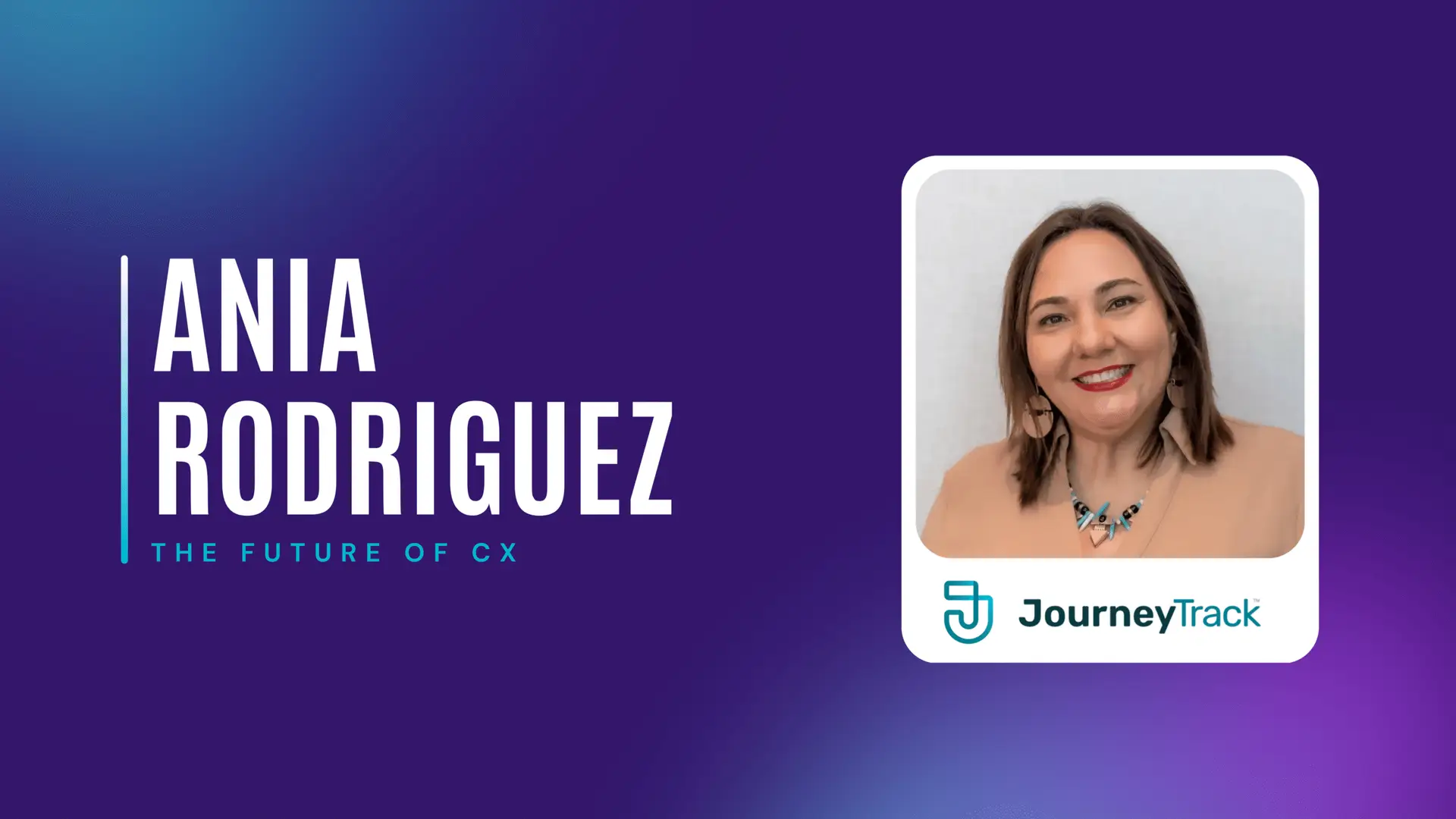
In this CX Minutes episode, Sabina Persson from Custellence is joined by Ania Rodriguez, Founder and CEO of JourneyTrack.
With nearly 30 years of experience helping organizations operationalize customer experience, Ania shares a clear message. CX leaders can no longer stop at insight. Accountability and action are becoming the real measure of impact.
CX Minutes with Ania Rodriguez and our host Sabina Persson, Custellence.
What’s covered in this episode
Guest insights
- CX as a system, not a project
- How AI elevates CX teams
- The end of mapping for mapping’s sake
- Why accountability is reshaping CX leadership
Quick links
CX as a system, not a project
For Ania, customer experience only works when it connects how teams operate with what customers actually experience.
When CX is treated as a system rather than a one off initiative, it removes guesswork. Priorities become clearer, ownership is easier to define, and teams can act instead of endlessly discussing insights.
This is where journey management replaces static journey maps and turns CX into something that can be governed, prioritized, and sustained over time.
Related: Insights Of How to Design for a Customer Growth Strategy
Deep dive: Experiencing A Customer Experience (CX) Failure? It’s Probably A Broken System, Not A Broken Employee (Forbes)
How AI elevates CX teams
AI has been part of JourneyTrack from the very beginning, not as an add on, but as a core capability.
“AI doesn’t replace CX professionals. It really elevates them by removing friction points and giving them leverage like they’ve never had before.” – Ania
Instead of manually maintaining journey maps, AI enables continuous synthesis of insights, triangulation across sources, and governance at scale. This allows CX teams to spend less time updating artifacts and more time driving outcomes.
The result is CX that is more reactive, scalable, and embedded in everyday decision making.
The end of mapping for mapping’s sake
One of the clearest shifts in CX today is the move away from documentation as the end goal.
As journey management platforms become a recognized category, CX work is evolving toward ownership, governance, and prioritization. Journey maps still matter, but only when they are connected to real decisions and measurable action.
This shift is what allows CX teams to stay relevant and effective over time.
Related: The end of mapping for mapping’s sake (Medium)
More like this: 5 Proven customer experience strategies to boost your business growth
👉🏽 Start your customer journey map
Why accountability is reshaping CX leadership
Looking ahead, Ania sees CX stepping out of the sidelines and into a more central business role.
“The future of CX belongs to accountability, moving from insight to delivery to outcome.”
As CX tools increasingly connect experience metrics with performance and financial metrics, the need to constantly justify the value of CX will disappear. Instead, organizations will move toward self improving journeys, supported by AI driven governance and operational playbooks.
This marks a fundamental shift. CX is no longer about influence. It is about execution.
Related: Accountability: The Non-Negotiable in Culture Transformation (CX Journey)
Key Takeaways
- Customer experience works best when treated as a system, not a project
- AI elevates CX teams by removing friction and enabling scale
- Journey management is replacing static journey mapping
- Accountability matters more than influence for modern CX leaders
“The future of CX belongs to accountability, moving from insight to delivery to outcome.” — Ania Rodriguez
👉 Want to learn more? Watch the full Episode #15 with Ania here.

Frequently asked questions (FAQ)
What is the difference between journey mapping and journey management?
Journey mapping focuses on visualizing experiences. Journey management adds ownership, governance, prioritization, and continuous action over time.
Will AI replace CX professionals?
No. AI supports CX professionals by removing manual work and enabling scale, clarity, and faster decision making.
Why is accountability becoming so important in CX?
Because CX is moving from insight generation to business impact, and impact requires ownership and execution.
Final thoughts
This episode makes one thing clear. CX is growing up.
As journey management, AI, and accountability become standard, customer experience is shifting from influence to execution and from support function to business system.
For CX leaders, the message is simple. Stop waiting for permission. Start owning the work.

AI Summary
Customer experience is evolving from static journey mapping to dynamic journey management, driven by AI, governance, and accountability.
In this CX Minutes episode, Ania Rodriguez explains why CX must be treated as a system that connects research, operations, leadership, and outcomes. AI plays a key role by removing friction and enabling scale, allowing CX teams to focus on execution rather than maintenance.
The future of CX lies in self improving journeys, measurable impact, and leaders who take responsibility for turning insight into action.
Read the transcript
Note: This transcript has been lightly edited for clarity and readability.
Intro
Sabina Persson 00:09
All right. Hi, I’m Sabina Persson from Custellence. Welcome to the video cast CX Minutes. It’s six questions, six minutes, and it’s all about customer experience.
This is a series of episodes where we bring you actionable insights, practical know how, and personal stories from top professionals, all in just six minutes.
And joining me today, I’m so happy to introduce Ania Rodriguez from JourneyTrack. Welcome, Ania. How are you?
Ania Rodriguez 00:38
Hey there, Sabina. Thank you for having me. A pleasure to be here.
Sabina 00:44
So good to have you here and I’m really excited. Today we’re going to talk about the future of customer experience. And as always, my first question is who are you and what do you do?
Who are you and what do you do?
Ania Rodriguez 00:52
Great, thank you. I’m Ania Rodriguez. I’m the CEO here at JourneyTrack and also the founder.
I’ve spent the last twenty seven years helping organizations evolve from isolated UX and CX efforts to enterprise journey management.
I also own Key Lime Interactive, which is a fairly large agency in the United States that works with a lot of Fortune five hundreds, and that’s really how JourneyTrack was born.
Today my work is solely focused on helping CX teams move from insight to real sustained business impact through JourneyTrack.
What role does customer experience play in your work?
Sabina 01:33
That’s so cool. Quick one. What role does customer experience play in your work?
Ania 01:41
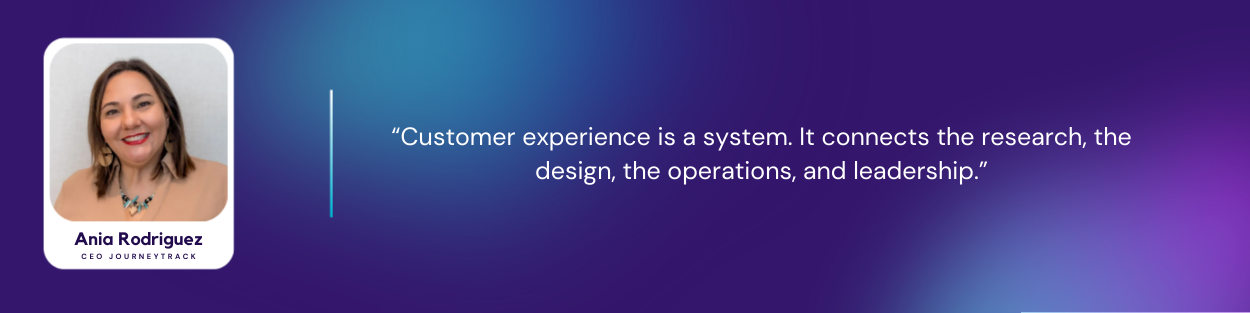
For us, customer experience is a system. It aligns what teams are actually doing with their customers.
In our work, it’s a mechanism that connects the research, the design, the operations, and leadership.
When done right, it eliminates guesswork, aligns priorities, and gives teams clarity on what they need to do next.
How do you see AI shaping the future of customer experience?
Sabina 02:00
And how do you see AI? It’s on everyone’s lips now, right? How do you see AI shaping the future of customer experience?
Ania 02:10
JourneyTrack was born with AI features from the start. We’ve been moving from manual journey mapping, which is what people traditionally did, to journey management.
That means making things less manual, more reactive, and scalable.
Now we’re leading efforts with agentic AI. What that does for us is help govern at scale, create triangulation, continuously synthesize insights, and risk actions.
To me, AI doesn’t replace CX professionals. It really elevates them by removing friction points and giving them leverage like they’ve never had before.
What is one CX trend people should pay attention to right now?
Sabina 03:00
That’s so interesting. In your opinion, what is one customer experience trend people should pay attention to right now?
Ania 03:06
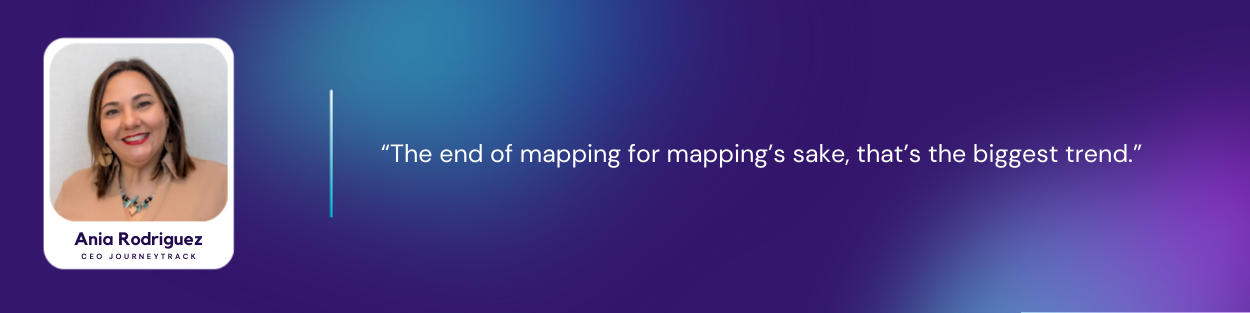
The end of mapping for mapping’s sake. That’s the biggest one.
Forrester just came out with their first version of the journey management platforms category, which we were part of. To me, that really solidified this as a new category versus just journey mapping.
What this means is ownership, governance, and prioritization, allowing CX teams to shift, make things actionable, and stay relevant.
What is one big change we will see in the next five years?
Sabina 03:45
Now imagine five years from now. What is one big change that you think we will see in customer experience?
Ania 03:58
I think CX will no longer sit on the sidelines.
Because tools today allow you to add performance metrics alongside financial metrics, the idea of justifying CX value is going to be gone.
That will probably happen in a year or two.
The bigger vision is really self improving journeys. A systematic approach to operationalizing CX, where the integration of agentic AI creates a playbook for leaders.
What is one piece of advice you would give to CX leaders?
Sabina 04:48
Now my final question. What is one piece of advice that you would share?
Ania 04:55
Stop asking for permission to act.
CX leaders spend too much time trying to navigate dynamics. The future of CX belongs to accountability.
Moving from insight to delivery to outcome. It’s no longer just about influence. It’s about accountability and governance at scale.
Wrap-up
Sabina 05:23
All right. That was all my questions. Thank you so much. That was some great stuff.
There are definitely goodies here for CX teams to take back and put into practice right away.
Thank you. It’s lovely to connect with you as always, and we’ll talk soon.
Ania 05:33
Absolutely. Thank you so much.
Sabina 05:39
And that’s all for today. Thank you for watching and I’ll see you next time. Bye.
Check out other episodes of CX Minutes here.
By Tove Lundell